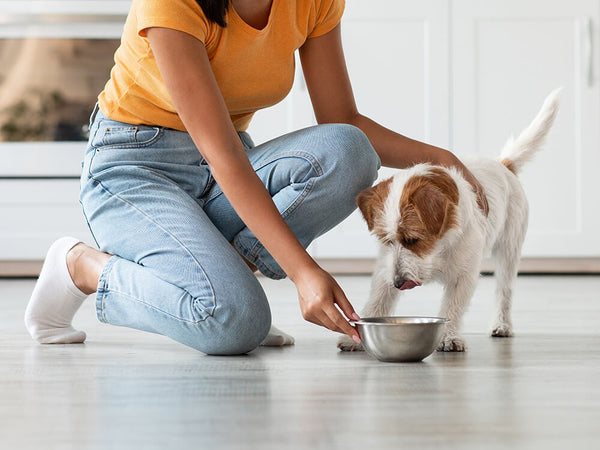
Is Your Pet too Pudgy?
By Dr. Jean Hofve
Pet obesity has been making the headlines in every
veterinary journal for the last few months. It is indeed a
serious problem for our furry friends. Many serious health
problems can result from obesity, such as arthritis, liver
disease, heart failure, and renal disease.
Prevention is key here: don’t allow your pet to become
overweight in the first place. Pay attention to your
puppy’s or kitten’s growth to make sure he does not fill out
“too much.” The average weight gain for a kitten is
approximately one pound per month up to 8-10 pounds. For
puppies it depends on breed, but you should never see
“rolls” of fat on a healthy puppy.
How can you tell if your pet’s too fat? You
should be able to feel the ribs easily. Even thin cats may
have a little “pooch” in the belly between the hind legs,
but this should not be excessive. From above, there should
be a bit of a waist, rather than a bulge, between ribs and
hips.
While nutritionists simplify obesity as a matter of “too
many calories in and too few calories expended,” it is
obviously not that simple. Obesity is a symptom of a
systemic imbalance, basically a disease state. Dieting
(starving) a pet down to his “ideal” weight does not address
the cause of the problem.
The most common contributor to pet obesity is
free-choice feeding. Dogs and cats are carnivores and
hunters. It is not natural for them to graze day and
night. Never allowing the intestinal tract to rest is a
contributor to many health problems down the road.
• In a multi-pet household, when one animal goes to the food
bowl, curiosity or the competitive instinct may cause
another to investigate and, while she’s there, take a few
nibbles. Enough nibbles over time can create a big problem!
• Boredom also plays a role. Pets that are home alone all day
may eat just for something pleasurable to do. Spending
quality time with your pet — play or walks with dogs, and play
therapy sessions for cats, will be a crucial part of a
weight loss program.
• Former strays who have had to struggle to survive on the
streets may have significant “food issues,” and will often
become overweight if food is too available.
For these reasons, we recommend feeding in timed meals
rather than leaving out food all the time. Having food
available 24/7 is far too tempting for too many animals. It
also does not allow you to monitor food intake, which can be
important. Now, you may say, “Oh, but I’m feeding a diet
food.” Well, most animals eat more of a diet food than of
regular food given the opportunity, because it is less
satisfying. This causes weight gain for the pet, and
frustration for you.
Another contributor to excess pet weight is treats. Once I had a patient, a 26-pound cat, whose owner swore
he only fed 1/4 cup of dry food per day. Oh, and 19 Pounce
treats every day. Now, come on folks, let’s be reasonable. If you ate a highly restricted, low-calorie
diet—supplemented with 19 Twinkies every day–what do you
think the result would be?! For a small pet, even a small
treat adds big calories. One “measly” ounce of cheese to a
20 pound dog is the same as 1-1/2 hamburgers for you; for a
cat, it’s equal to 3-1/2 hamburgers. If your pet is a
confirmed treat junkie, don’t eliminate them, just limit
them. Break one treat into 5 little ones instead of giving
5 whole treats. Your pet will still get just as much
enjoyment – but far fewer fattening calories!
I don’t like to put pets on a “diet.” Diets must often
be severe in order to comply with current calorie theories,
and this may cause even worse problems, such as
life-threatening liver disease in cats.
Animals may consume excessive amounts of a food because
they can’t digest it properly, there aren’t enough of
certain nutrients, or some nutrients are not in a
“bio-available” form – that is, they can’t be assimilated
properly. This is a concern with some of the most
inexpensive and generic foods, as well as with some “diet”
foods that contain excessive levels of fiber. Meal feeding
allows the pet to choose, and is much safer.
Dry food is actually where the most dangerous calories
are. The feline in particular is uniquely adapted to
get energy from protein and fat; the cat’s natural prey
contain very little carbohydrate. For most cats,
carbohydrates are converted to fat, rather than burned for
energy. Clearly, this is the opposite of where we want to
go!
There are two major strategies for helping a fat pet
lose weight.
• Feed in timed meals. For most dogs and cats,
it’s best to feed them on a timed-meal schedule. That is,
don’t leave the food out all the time, but rather put the
food out for 30-45 minutes, two or three times a day. Dogs
will usually inhale their food in seconds. Some cats prefer
to eat a bit, come back in 10 minutes and eat a bit more. But… cats figure out this schedule quickly. Not all cats
will lose weight with this change alone, but usually you can
keep them from continuing to gain. (Caution: some medical
conditions require special feeding regimens; talk to your
veterinarian before making any changes.)
• Feed more wet food. Dogs lose more fat and
retain more lean body mass on a high protein, low
carbohydrate diet, so a shift away from high-calorie dry
food will benefit your dog. In general, cats should receive
at least 50 percent of their diet as wet food, either
good-quality canned foods or homemade diets. For
significant, healthy weight loss, feed 100% wet food
(including cans, pouches, homemade, and raw frozen) and get
rid of the dry altogether. Always make sure kitty is
eating; some cats are so addicted to their dry food that
they will go on a hunger strike without it. Be sure you
work closely with your veterinarian when changing diets to
minimize the risk to your cat.
For a dog, think “Zone” diet. Moderate proteins
and fats, complex carbohydrates (vegetables) rather than
starchy ones like corn, potatoes, and grains. This requires
reducing or even eliminating most dry foods, even the
grain-free varieties, many of which substitute high-sugar carbs like
potatoes and yams for grains.
A high-protein, high-fat, low-carbohydrate diet like
“Atkins” is truly ideal for the cat. Most canned cat and
kitten foods meet these standards, but try to choose those
with the least carbohydrate. You can get a fair idea of
carbohydrate content by simply subtracting all the listed
percentages on the label from 100%. About 8% carbohydrate
(or less) is best.
Don’t forget exercise as a health-giving way for your
pet to lose weight (and it won’t hurt you, either!).
Walking or vigorous outdoor play with your dog obviously
benefits both of you. It’s a little harder with cats, but
play therapy is good exercise, builds her confidence, and
strengthens the bond between the two of you.
Throughout the weight management process, whatever the
results, give your pet plenty of love and attention. Lots
of affection will help her equate love and comfort with
you – and not the food bowl.